What's New in 4.2.0
Released 19 March 2026.
4.2.0 answers a question that gets asked as soon as more than a handful of people share an installation: how do you manage access by team rather than by individual? User groups, group permission templates and group-based zone ownership are the answer. Alongside that, the module system made several features optional, and BIND zone files became importable.
Note: The generated release notes for 4.2.0 on GitHub are cumulative rather than incremental, because 4.1.0 and 4.2.0 were developed on parallel branches. Several features listed there - SAML, OIDC, avatars, forgot username, database SSL, the zone deletion permission split, DNS wizards, WHOIS and RDAP - actually shipped in 4.1.0. This page lists only what 4.2.0 genuinely added.
Highlights
User groups
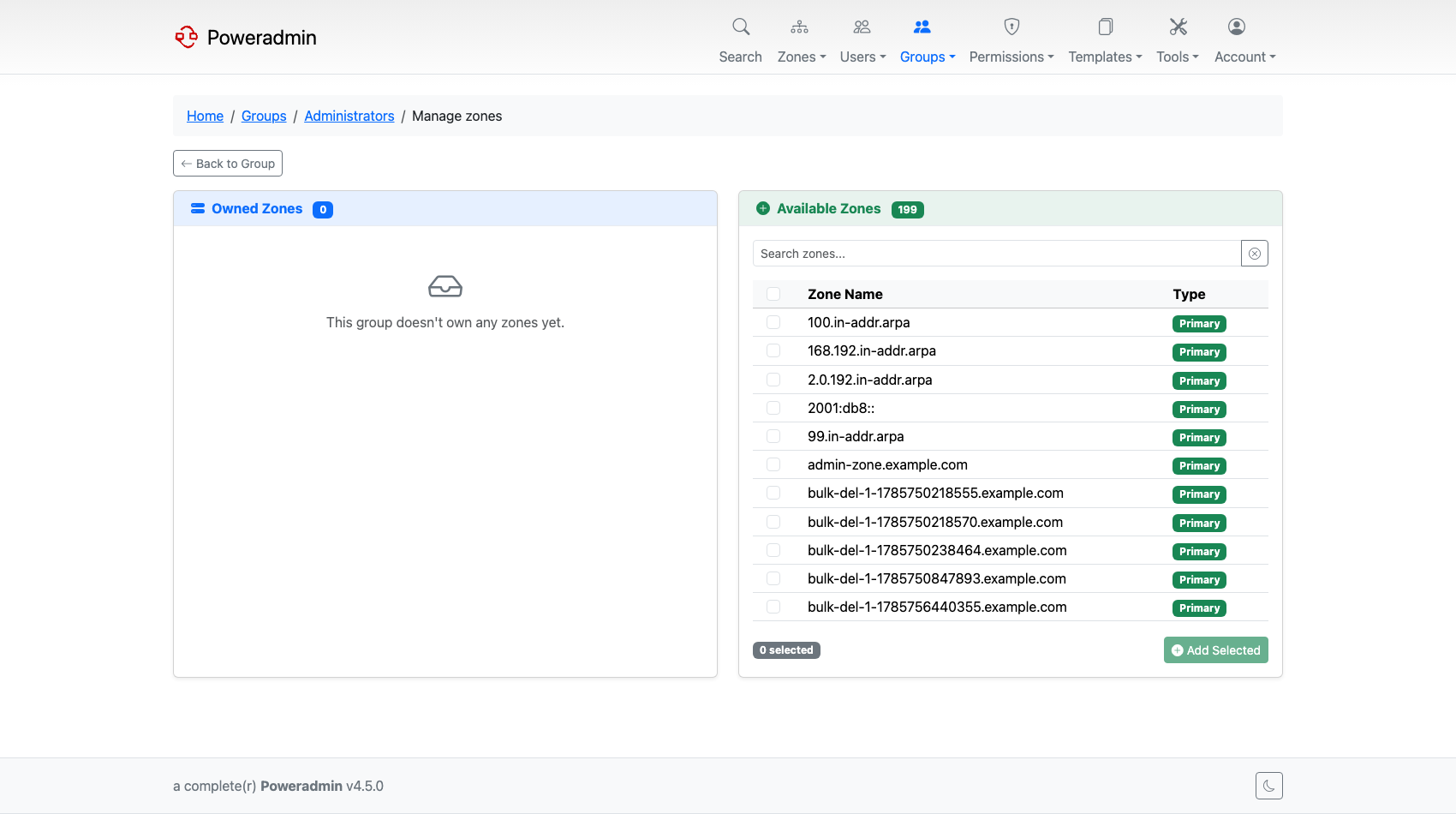
Groups are first-class. A group has its own permission template, its own members, and its own set of zones. Members inherit the group's permissions on top of whatever they hold individually.
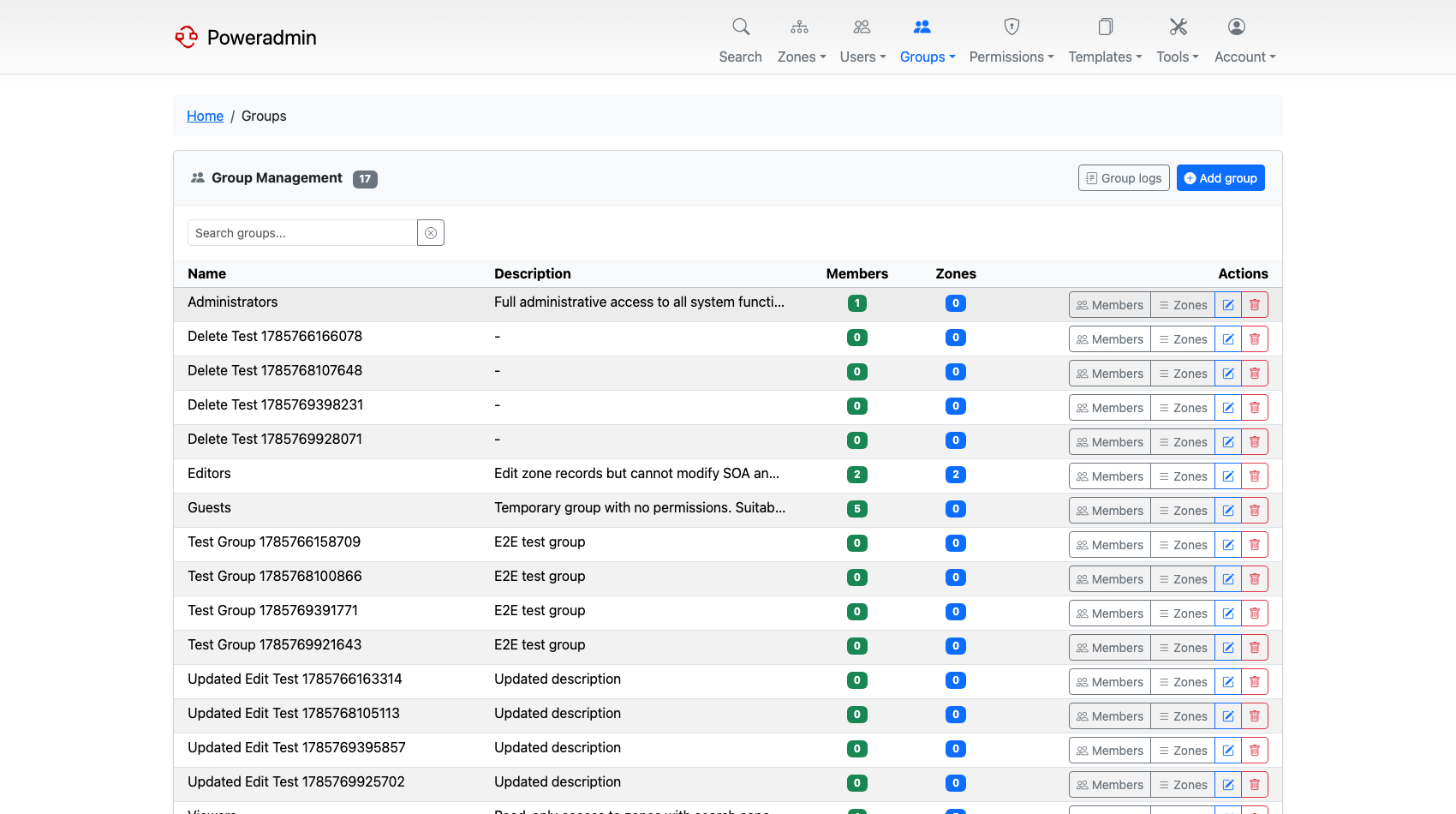
Five group permission templates ship out of the box: Administrators, Zone Managers, Editors, Viewers and Guests. The existing user templates were renamed at the same time, so DNS Editor became Editor, Read Only became Viewer, and No Access became Guest.
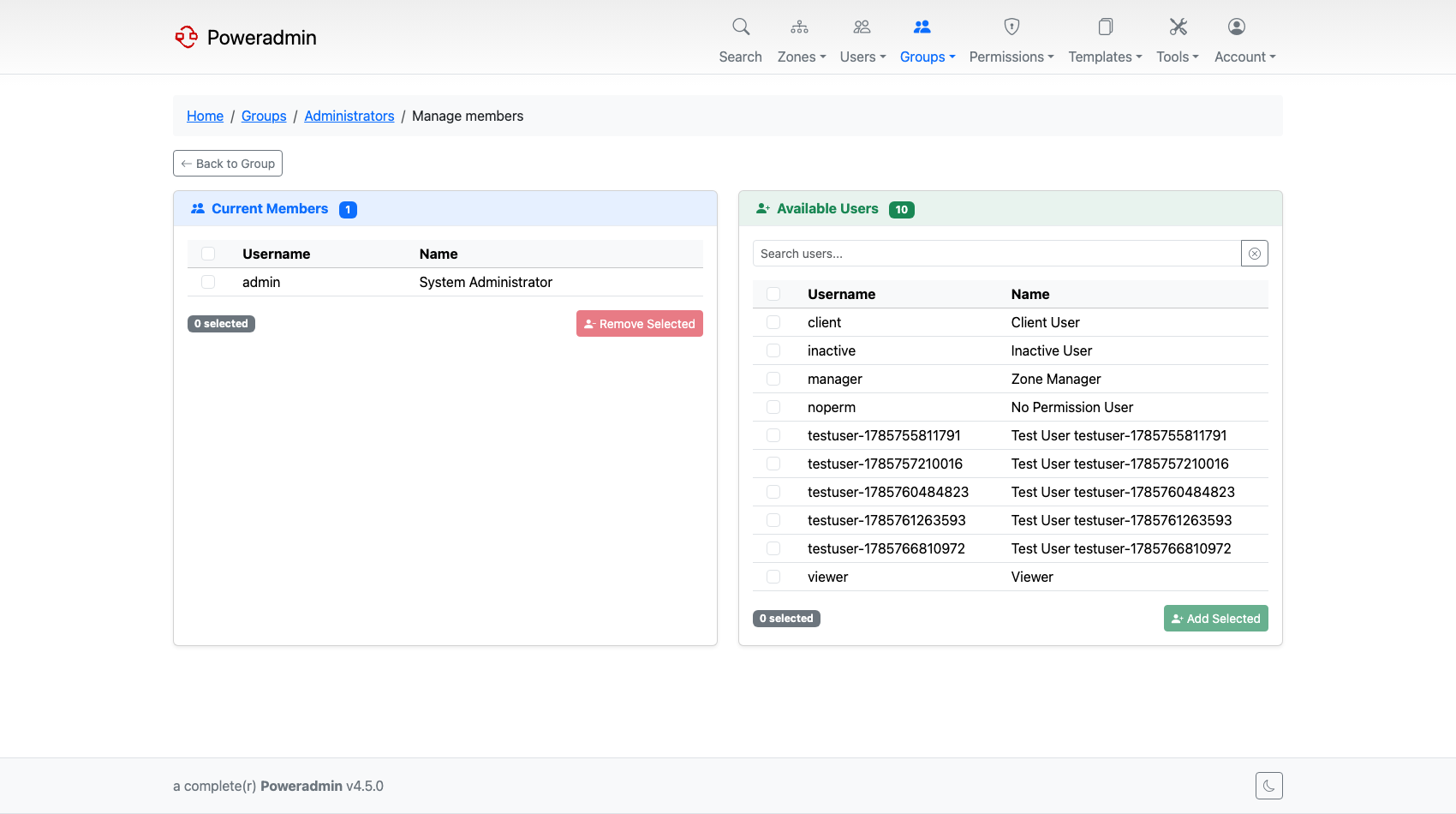
See User Groups.
Group-based zone ownership
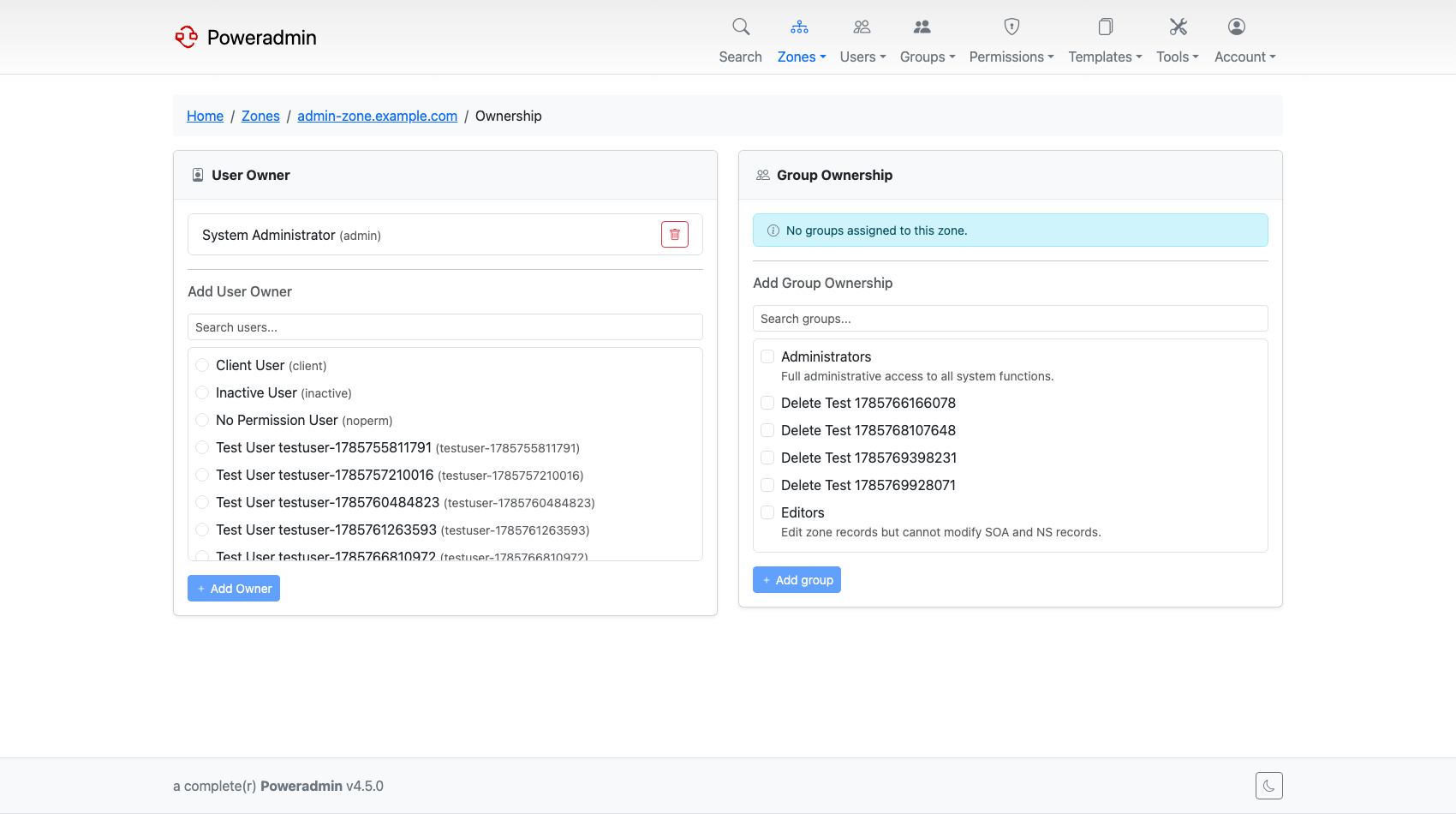
A zone can be owned by a group instead of, or in addition to, individual users. The owner
column became nullable, so a zone can belong purely to a group and stay accessible when the
person who created it leaves.
A dedicated ownership page manages both kinds of owner for a zone.
See Zone Management and User Groups.
The module system
WHOIS, RDAP, DNS wizards, CSV export, email previews and zone import/export became modules.
Each can be enabled or disabled independently, and each can be restricted to administrators,
through a modules block in the configuration or through PA_MODULE_* environment variables
in Docker.
This is how you strip the interface down to what your users actually need.
See Basic Configuration.
BIND zone file import and export
Upload a zone file to create a zone, or merge it into an existing zone with a conflict strategy that decides what happens when a record already exists. Zones can be exported back out as BIND files.
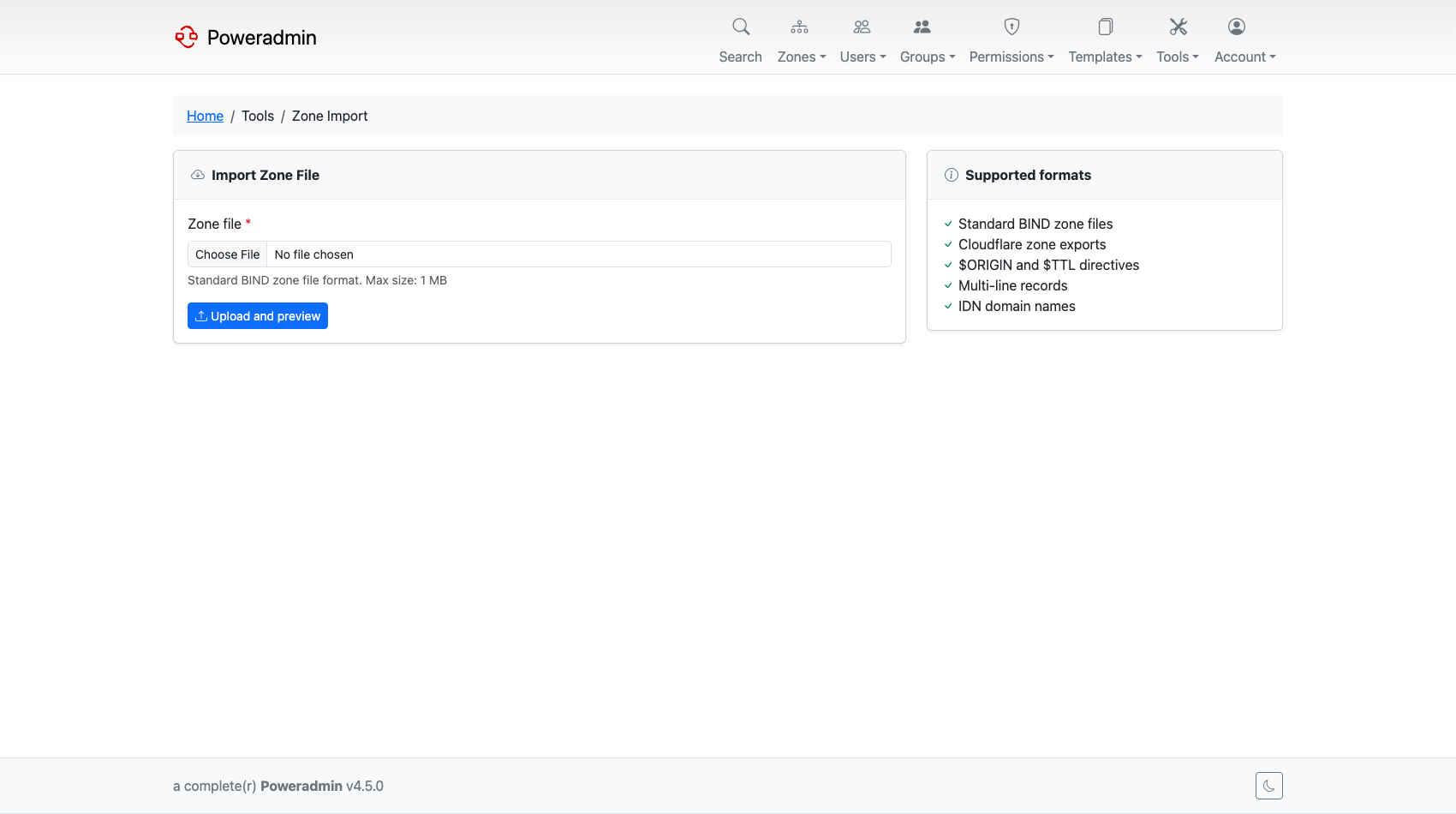
See Zone Import/Export.
MFA enforcement
Multi-factor authentication stopped being purely opt-in. The user_enforce_mfa permission
and the security.mfa.enforced setting let you require it for particular users or for whole
groups, and the user list gained an MFA status column so you can see who has enrolled.
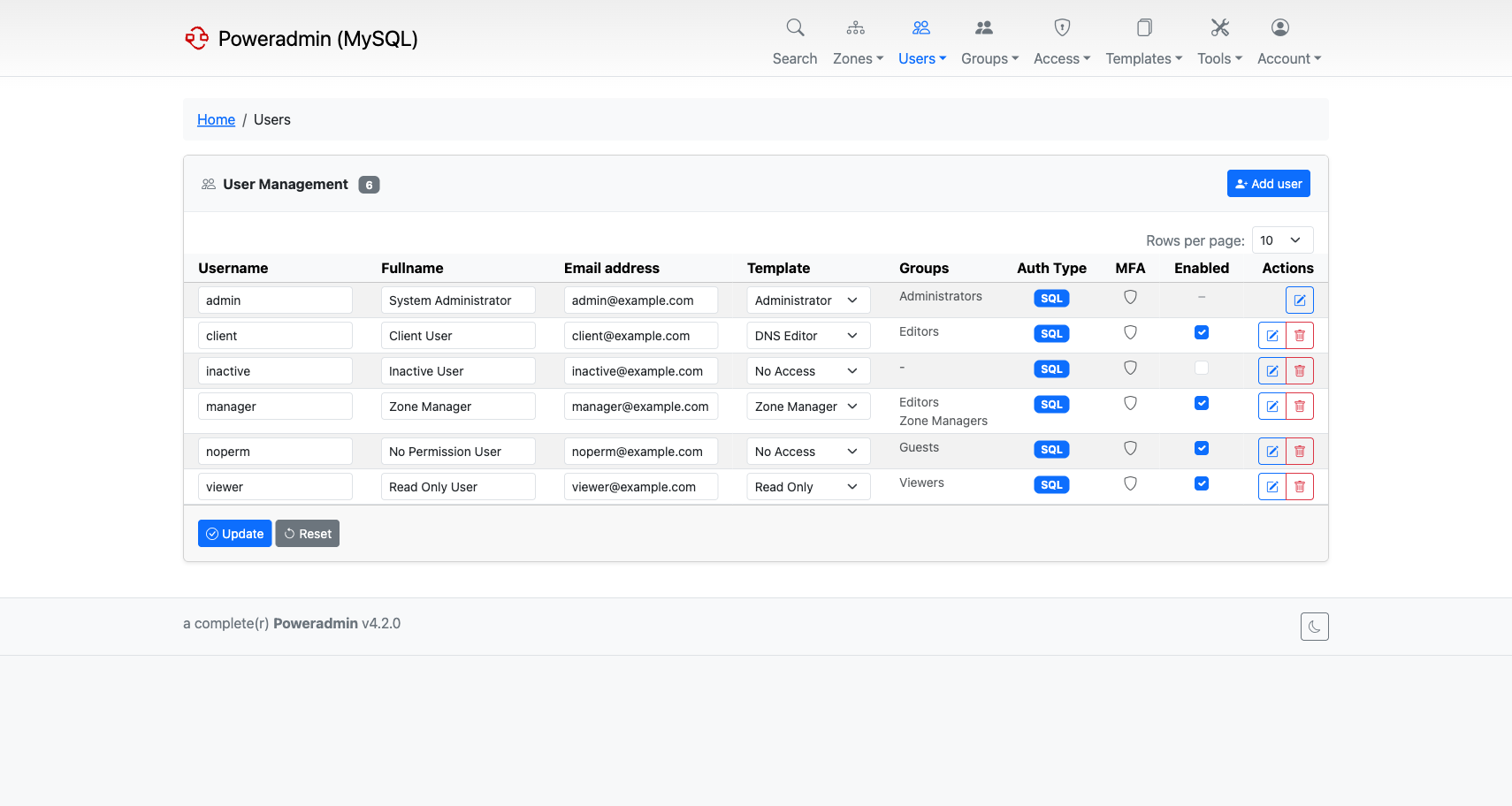
See Multi-Factor Authentication.
API v2 expansion
Three new endpoint families: zone owners (including batch assignment through a user_ids
array), zone templates with full CRUD over their records, and groups with their members and
zones.
See Endpoints.
Also in this release
| Feature | What it does | Where |
|---|---|---|
| Save zone as template | Turn an existing zone into a reusable template | DNS Templates |
| Per-record comments | Comments attach to a single record rather than the whole RRset | Zone Management |
| Group activity log | An audit page for group creation, membership and zone changes | Database Logging |
| User list improvements | Pagination, group membership and MFA columns, username shown alongside full name | Users and Roles |
| Collapsible sidebar | Sidebar sections can be collapsed in the modern theme | Themes |
| Deprecated record type warnings | The record type selector flags types that are no longer recommended | Record Type Customization |
| Two-column zone creation | The add-zone forms were reorganised | Zone Management |
| IPv6 display shortening | Long IPv6 addresses and reverse zone names are abbreviated in listings | Reverse DNS |
| Custom CA certificates | TRUSTED_CA_FILE mounts a CA bundle into the container |
Docker Installation |
| Five new locales | Indonesian, Korean, Swedish, Ukrainian and Vietnamese | Basic Configuration |
Patch releases
| Release | Added |
|---|---|
| v4.2.1 | IDN and punycode conversion for record names and content; IPv6 batch PTR with correct nibble expansion; database logging of user creation, deletion and SSO logins; rootless containers |
| v4.2.2 | TRUSTED_PROXIES for real client IPs behind a proxy; the API Keys menu shown to holders of api_manage_keys; a .za WHOIS server |
| v4.2.3 | Forwarded-IP headers trusted only from private and loopback peers |
| v4.2.4 | OIDC and SAML URLs pinned to interface.application_url; SOA, NS and apex records pinned to the top of the record list; CSV export quotes values that spreadsheets would treat as formulas |
| v4.2.5 | A per-zone Logs button on the zone editor; large forms handled correctly when they exceed PHP's max_input_vars |
Warning: v4.2.5 changed the zone edit form. If you maintain a forked theme, re-sync your
edit.htmlagainst the shipped version. The new hidden marker fields are what tell the form which rows changed, and without them a zone save silently persists nothing.